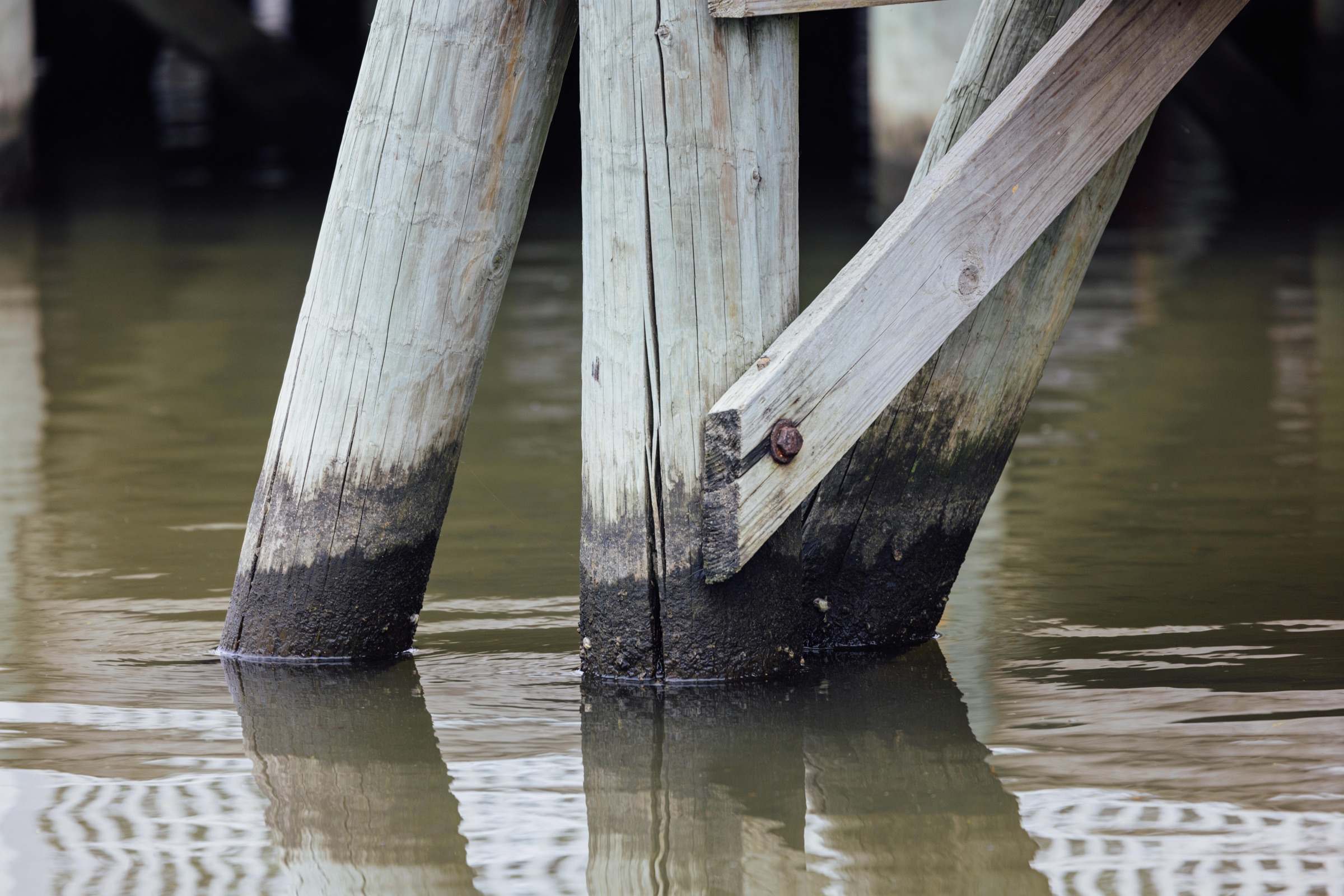
Sheared or leaning pilings
Wave and surge load snaps or racks pilings out of plumb.
Dock piling replacementHurricane surge, wind, and fallen-tree damage assessed and repaired across Hilton Head Island and Bluffton — from temporary stabilization through permitted rebuild, documented for your insurance file.
Photographs taken before anything is moved are the most useful thing you can bring to the first conversation.
Hilton Head Marine Construction assesses and repairs storm-damaged docks, boat lifts, and bulkheads across Hilton Head Island and Bluffton — call (843) 508-5850. Before anything is moved, photograph the damage and note the storm and date: that record is what both the insurance claim and the SCDES permit determination are built from. Temporary stabilization can start right away; permanent rebuilding waits on the permit path.
Last updated: September 2026
Six steps, in this order. The order is what keeps the insurance claim and the permit path intact — almost every complication on a storm-damage job comes from doing one of these out of sequence.
Wide shots of the whole structure, then close frames of each failure — racked pilings, torn decking, a lift cradle in the water, soil escaping behind a bulkhead. Include debris where it landed. An adjuster needs to see the damage as the storm left it, not after a week of cleanup, and the same photographs are what a permit determination is made from.
Name the storm and record the date and time the damage occurred. Wind and storm surge are usually covered by two different policies, so tying the damage to a specific event — and, where you can tell, to a specific mechanism — decides which carrier answers for it.
A dock that has lost pilings is carrying load through framing that was never sized for it. Temporary measures that prevent further loss — bracing a leaning piling, securing loose decking, removing an immediate hazard — are not the permitted repair and do not authorize the rebuild that follows.
Hilton Head Marine Construction assesses and repairs storm-damaged docks, boat lifts, and bulkheads across Hilton Head Island and Bluffton. Send the photographs with the call — they are the fastest way to scope a job without waiting on a site visit, and the written assessment that follows is what an insurance claim is built on.
Most policies require notice of loss before repair, not after. Open the claim, hand the carrier the dated photographs and the written assessment, and keep temporary stabilization separate in the file from the permanent rebuild.
In-kind repair of a dock that is still generally intact is treated as maintenance. A dock that has to be reconstructed goes through a general permit, and after a declared emergency SCDES has a no-fee Emergency General Permit for restoring a previously permitted or grandfathered structure to its exact prior condition. Which one applies is settled before work starts, not after.
Wave and surge load snaps or racks pilings out of plumb.
Dock piling replacementWind uplift and floating debris strip boards and fasteners.
Dock decking replacement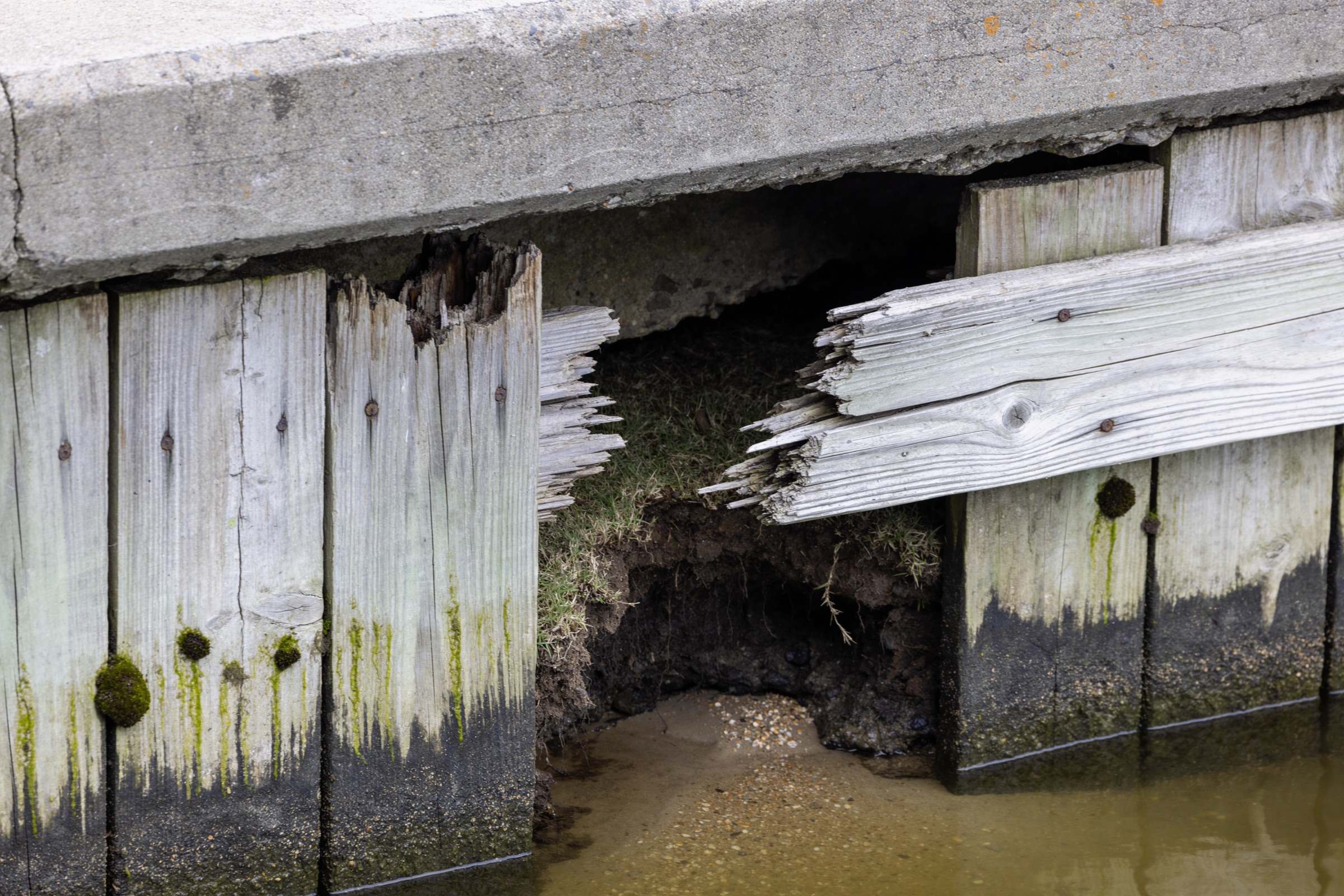
Surge overtops or undermines the wall, pulling tie-backs loose.
Bulkhead & seawall repairsWave action and wind twist cradles and snap cables.
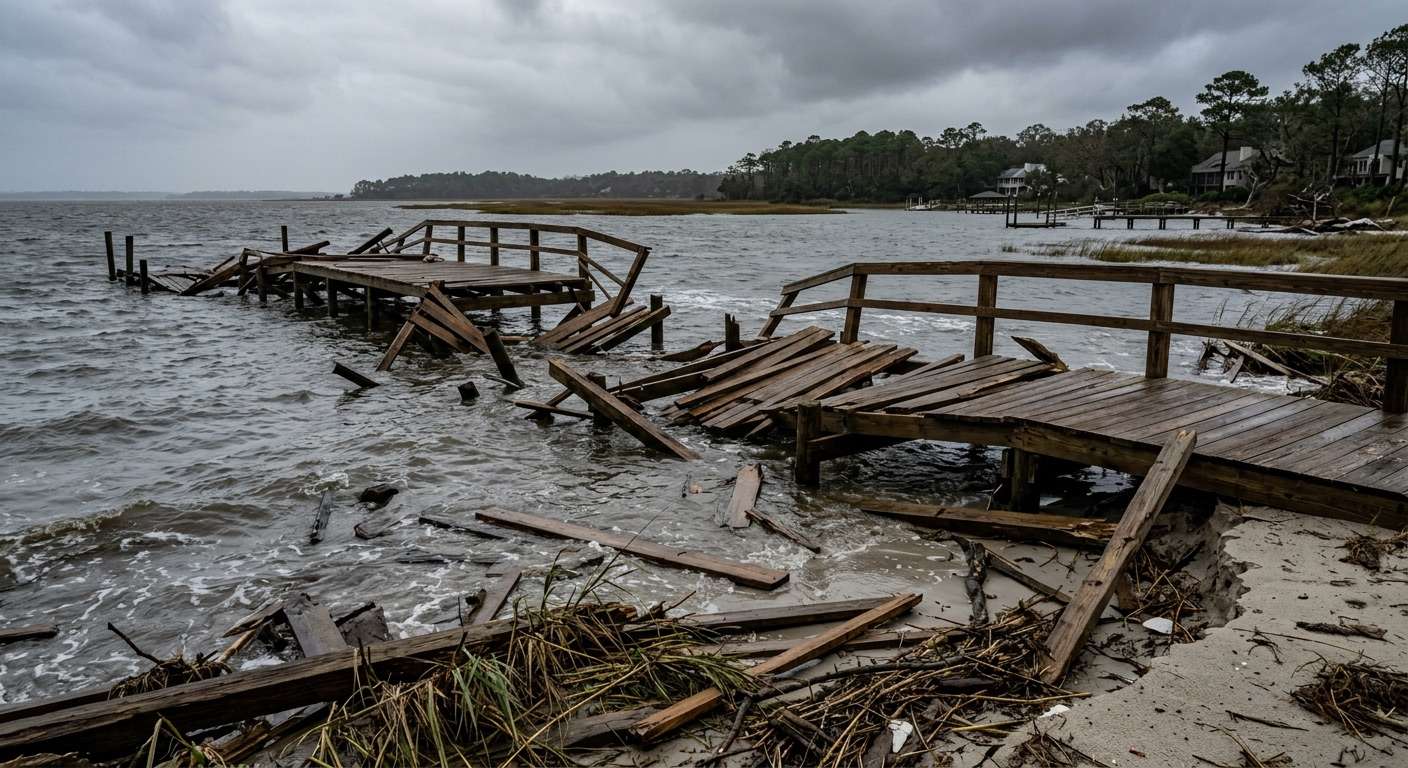
Boat lift repairsSurge can take a dock apart in a single tide. What a permitted in-kind rebuild puts back is the same structure, on the same footprint.
Describe the damage and send photos. Photographs of the damage are the fastest way to scope a job without waiting on a site visit.
On-site inspection of pilings, decking, and hardware — above and below the mudline.
Bracing or securing to stop further loss while permanent repair is scoped.
Repair versus replacement classified against SCDES Critical Area rules and USACE SAC-RGP-09.
Permitted work completed and documented for your insurance file.
A dock is usually insured under a homeowners policy's “other structures” coverage. Wind damage is typically included, often subject to a separate named-storm or hurricane deductible on a South Carolina coastal policy; storm surge and wind-driven water are standard exclusions and are covered only by separate flood insurance. Terms vary by carrier, so the declarations page and your agent are the authority on your own policy — what follows is the documentation sequence, which does not.
The order is the part people get wrong. An adjuster needs to see the damage as the storm left it, and most policies require notice of loss before repair rather than after.
Photograph all damage before anything is moved or removed
An adjuster values what they can see. Photographs taken before cleanup are the only record of the damage in its original state, and they cannot be recreated later.
Record the date, time, and name of the storm
Wind damage and storm-surge damage are usually handled by two different policies. Tying the damage to a specific event is what starts that determination.
Notify the carrier and open the claim before permanent repair begins
Most policies require notice of loss before repair, not after. Work done first is the most common reason a straightforward dock claim gets complicated.
Get a written, itemized assessment from a marine contractor
It should say what failed, what caused it, and what repair or replacement the damage requires — itemized by structure, since a carrier may treat a dock, a lift, and a bulkhead under different coverage lines even though one storm damaged all three.
Keep temporary stabilization separate from the rebuild in the file
Preventing further loss is expected of you and generally does not conflict with the claim. Starting the permanent rebuild before the claim is filed does.
Rebuild under the permit category the damage actually falls into
The permit determination and the claim are built from the same file of dated photographs and assessments, which is why the two sequences are really one sequence.
Temporary stabilization that prevents further loss — bracing a leaning piling, securing loose decking, clearing an immediate hazard — is not the permitted repair and generally does not wait. Permanent rebuilding does. After a declared emergency, SCDES offers a no-fee Emergency General Permit that covers reconstruction of a previously permitted or grandfathered structure to its exact prior size, configuration, and location. It is an expedited lane, not an exemption: the coverage still has to be applied for and approved before the rebuild is authorized.
Outside a declared emergency, storm damage runs through the ordinary categories. In-kind repair to a dock that is still generally intact and functional, within its original dimensions, needs no new SCDES permit. Reconstruction of a dock that is still generally intact goes through a reconstruction general permit. Anything that changes the footprint, length, or configuration is an individual Critical Area permit for minor activities. A federal authorization from the USACE Charleston District applies alongside the state one.
One date is worth knowing before the rebuild is put off: state regulation allows a destroyed dock to be rebuilt to its previous configuration only if reconstruction is completed within five years of the event.
SCDES writes and administers the rule; the Charleston District authorizes the federal side. Read them at the source rather than taking a contractor's summary for it — this page included.
The no-fee post-declared-emergency category, and its limit to the structure's prior permitted or grandfathered condition.
The permit categories a storm repair can land in: Normal Maintenance & Repair, General, Minor Activities, and Emergency General.
How the Bureau of Coastal Management operates after a storm, including notification of county and municipal emergency orders.
Specific project standards for tidelands and coastal waters, including the five-year window to rebuild a destroyed dock to its prior configuration.
The federal regional general permit for private docks in South Carolina navigable waters, which applies alongside the state permit.
Hilton Head Marine Construction is a marine contractor, not a government agency. What we carry is the practitioner's half of the process: the on-site assessment of what failed, the dated photographs and drawings an application is built from, the determination of which permit category the damage actually falls into, and the permitted repair itself once it is authorized. SCDES decides the application.
Hilton Head Marine Construction is South Carolina licensed and insured. A certificate of insurance for the job is available before work begins.
Nothing on this page is legal or insurance advice. Confirm current requirements with SCDES and your own carrier.
A storm does not hit the island evenly. Open sound and river frontage takes the wind and the surge first; a locked harbour behaves differently again; an interior lagoon mostly sees fallen trees. Inside a plantation or gated community there is also a property owners’ association or architectural review submission running alongside the state permit, and a gate and contractor-access process that decides when a crew and a barge can reach the water at all. Each community below has its own page.
Not listed? See the full service area — off the island we also work Daufuskie Island and travel toward Beaufort, Lady’s Island, and Port Royal on request.
Call a marine contractor who works this coast: Hilton Head Marine Construction, (843) 508-5850, assesses and repairs storm-damaged docks, boat lifts, and bulkheads across Hilton Head Island and Bluffton, including inside the island's plantation and gated communities. Photograph the damage before anything is moved, then call. Hilton Head Marine Construction is South Carolina licensed and insured.
Photograph everything before it is moved or cleared, and record the storm and the date. Stay off the structure, and stabilize only what is dangerous. Then get a written assessment, file the insurance claim, and have the permit category determined before any permanent rebuilding starts — work done out of order complicates both the claim and the permit.
Temporary measures that prevent further loss — bracing a leaning piling, securing loose decking — don't rebuild the structure and aren't themselves the permitted repair. After a declared emergency, SCDES offers a no-fee Emergency General Permit to reconstruct a previously permitted or grandfathered structure to its exact prior condition, but that coverage still has to be applied for and approved before the rebuild is treated as authorized.
Emergency General Permits are a SCDES Bureau of Coastal Management category available after a declared emergency under S.C. Code §48-39-10(U). They carry no fee and cover reconstruction of a previously permitted or grandfathered structure to its exact prior size, configuration, and location — and they still require an application and Department approval before the rebuild is authorized. The application is prepared from the same dated photographs and assessment the insurance claim uses.
Typically a dock falls under a policy's "other structures" coverage, with wind damage usually included (often subject to a separate hurricane deductible) while storm surge and wind-driven water are standard exclusions requiring separate flood coverage. Terms vary by carrier — document the damage and file the claim before starting permanent repairs.
Usually not under the homeowners policy alone. Surge and wind-driven water are standard exclusions on most homeowners policies and are covered only by separate flood insurance, through the NFIP or a private policy. A dock racked by wind is generally a wind claim; the same dock lifted off its pilings by surge is generally a flood claim. One storm often causes both, which is why a component-by-component written assessment matters.
Not under the emergency permit. SCDES's Emergency General Permit restores a structure only to its exact prior size, configuration, and location; anything larger or different is reviewed under the standard Minor Activities or reconstruction general permit process, on its normal timeline. State regulation also allows a destroyed dock to be rebuilt to its previous configuration only if reconstruction is completed within five years of the event.
Temporary stabilization can usually happen within days of the call. The permanent rebuild runs on the permit path, not the construction schedule: an in-kind repair to a dock that is still generally intact needs no new SCDES permit and moves at the pace of crew and tide access, while a reconstruction or a footprint change waits on review. After a widespread storm, contractor availability across the island becomes the other constraint.
Yes. Hilton Head Marine Construction works inside the island's plantation and gated communities as well as on open creek and sound frontage, where a property owners' association or architectural review submission runs alongside the state permit path — and, after a storm, alongside a gate and contractor-access process that decides when a crew and a barge can actually reach the water.
Photograph the damage before anything is moved or cleared, and note the date of the storm. That record is what an insurance claim is built on, and it is usually enough to say whether a structure needs assessing this week or this season.