Dock Construction on Hilton Head Island, SC
New dock construction on Hilton Head Island, SC — a dock builder's full scope, from the SCDES permit and the community's architectural review through the last fastener, engineered for the pluff mud and the tidal range you actually have.
How long does it take to build a dock on Hilton Head Island?
Most of a dock project's timeline is permitting, not construction. A new private dock needs SCDES Critical Area review and federal authorization before any piling is set, and inside a gated community it also needs POA or ARB approval. Build time is measured in weeks; approval is measured in months.
Last updated: August 2026
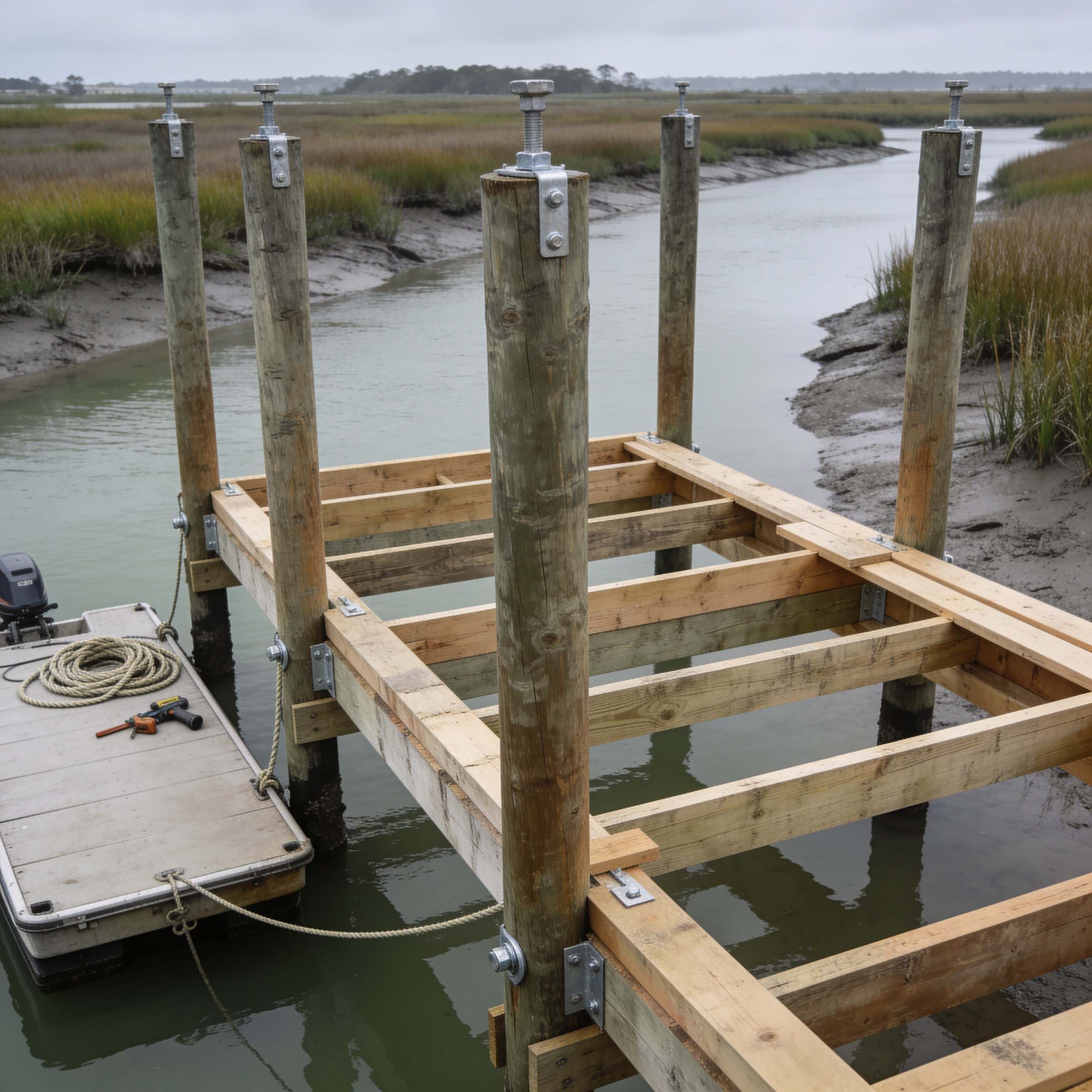
How long does it take to build a dock on Hilton Head Island?
SCDES — the South Carolina Department of Environmental Services — runs a 15-calendar-day public notice on every minor-activity application, and the applicant has to run a matching newspaper notice within that window before the file can move forward. Add drawing preparation, adjoining-owner notification, and the federal pre-construction notification the U.S. Army Corps of Engineers (USACE) requires under the South Carolina Dock Regional General Permit, and six to ten weeks of review is a realistic floor even on a straightforward site.
Once approval is in hand, the build itself is scheduled around tide windows for barge access and weather, not around the permit. A single dock typically takes one to three weeks on site once work starts, depending on length, pile count, and whether a lift or floating section is part of the scope.
What a dock permit application actually requires
A minor-activity application needs professional-stamped drawings, a notarized affidavit of ownership, the names and addresses of every adjoining property owner, a $250 filing fee (reduced to $150 for docks with walkways under 100 feet), and a newspaper public notice run within 15 days of SCDES's own notice.
SCDES will not accept hand-drawn plans — drawings have to be produced, stamped, and signed by a South Carolina–licensed land surveyor, professional engineer, or landscape architect, and an application with drawings judged inexact is returned rather than placed on notice. Getting a licensed set drawn before the file is submitted, not after a rejection, is the fastest path through.
We prepare the drawing package, run the affidavit of ownership, notify adjoining owners, and carry the newspaper notice and affidavit of publication back to SCDES — the paperwork is carried as part of the job, not handed back to the owner mid-project.
Where the dock can go: setbacks, corridors, and marsh crossing
State regulation sets a 20-foot setback from your extended property lines on both sides, and the dock has to reach the first navigable creek within that corridor — the one with a defined channel or an established history of navigational use. Crossing to a different, more convenient creek is allowed only in rare geographic circumstances.
The corridor is your property's own side lines projected straight out into the water; a dock built outside it encroaches on a neighbor's access. Joint-use docks shared by two adjoining owners are the one exception to the 20-foot setback, since both owners are party to the same structure. A dock is also capped at 1,000 feet of total length over Critical Area, inclusive of the pierhead, floats, lift, ramp, and mooring piles.
The lot itself has to qualify: a private dock needs 75 feet of frontage at the marsh edge and 75 feet between its extended property lines at the point the dock is built; a joint-use or community dock needs 50 feet on both counts. A lot under 50 feet wide at the marsh edge does not qualify for a dock at all, which is worth knowing before a purchase, not after.
Pluff mud and the piling method it dictates
Pluff mud is soft, anaerobic tidal sediment, and its depth at a given site decides whether pilings are jetted into place with high-pressure water or driven with an impact hammer. Get the method wrong for the mud and a piling that looks set on day one loses fixity within a season.
Jetting works sediment out from under a piling and lets it settle into place under its own weight and the crew's guidance — the right approach where mud runs deep and driving would meet no resistance to set against. Where mud is shallower and gives way to firmer strata, driving seats the piling against real bearing capacity. Probing the mud before pilings are ordered is part of the job, not an afterthought.
Layout for a large tidal range: fixed pierhead, floater, or both
A fixed pierhead sits at a constant elevation and works well for a dock used at most stages of the tide; a floating dock rides the water and keeps a boat at a workable height even at dead low, which a fixed structure alone cannot do on this coast's tidal range.
Most Hilton Head Island properties end up with both: a fixed walkway and pierhead for the bulk of the structure, with a floating section or gangway-connected float doing the work of keeping a boarding surface near the waterline through the swing. Gangway slope at low tide is the detail that gets missed on paper and felt underfoot — too short a gangway on too great a tidal range makes for a steep walk twice a day.
Materials and fasteners for brackish water
Framing lumber, decking, and hardware all have to be rated for continuous salt exposure, not just treated for ground contact — the difference matters because a dock sits in brackish water and salt spray every day of its service life, not occasionally.
Hot-dip galvanized or stainless fasteners are standard; mixing dissimilar metals at a connection sets up galvanic corrosion that eats the less noble metal first, often invisibly, until a fastener lets go under load. Piling material — treated timber versus composite or concrete — is chosen against the site's marine borer pressure and the owner's maintenance horizon, not by a single default spec applied everywhere.
POA and ARB review inside gated communities
Inside a gated community, a new dock also needs approval from the property owners' association (POA) and, in most communities, an architectural review board (ARB) — a separate process from SCDES review, run on its own timeline, and required alongside the state permit rather than instead of it.
Sea Pines, Wexford, Long Cove, Windmill Harbour, and Palmetto Bay each run their own submission requirements, and a set of drawings that satisfies SCDES does not automatically satisfy an ARB's aesthetic or dimensional standards. We carry both submissions as one coordinated package rather than sequencing them as two separate projects, since ARB conditions sometimes affect what the state drawings need to show.
What the build looks like week by week
Once permits are in hand, a typical boat dock build runs piling installation first, then framing, then decking and hardware, then any lift or float — sequenced around the tide windows that give equipment access to the site, usually completed in one to three weeks depending on scope.
Piling day depends on a barge or marsh buggy reaching the site at the right tide state, which is why a firm calendar date is harder to promise than a build window. Framing and decking follow once pilings have set, and a boat lift, if part of the scope, is usually the last piece installed since it needs the finished structure to mount to.
How much does a dock cost on Hilton Head Island?
On Hilton Head Island and in Bluffton, a new private dock typically costs about $35,000 to $150,000. The low end is a short fixed dock on a protected creek. The high end is a larger dock on open sound with a boat lift, composite decking, or concrete pilings, and some jobs run past that. Repair of an existing dock is usually less. Mud depth, how far the walkway has to run to the first navigable creek, piling count, barge access, and the permit category move a specific job inside or outside that band.
The site visit measures the frontage, probes the mud where pilings would go, finds the first navigable creek inside the property corridor, and names the permit category. Hilton Head Marine Construction quotes against that scope. Call (843) 508-5850.
How to choose a dock builder on Hilton Head Island
Judging dock builders on Hilton Head Island comes down to three things a homeowner can actually check, and none of them is a gallery of finished docks. The first is whether the builder carries the permit rather than handing it back: SCDES will not accept hand-drawn plans, so ask who prepares the stamped drawing package, who notifies the adjoining owners, and who runs the newspaper notice. The second is whether they have built inside your community before, because a set of drawings that satisfies the state does not automatically satisfy an architectural review board.
The third is the mud. Ask how the piling method will be decided on your site — probed before pilings are ordered, or assumed from the last job down the creek. Jetting and driving suit different sediment depths, and a piling set by the wrong method looks fine on day one and loses fixity within a season. A builder who answers that question with a number rather than a plan to find one is guessing.
Hilton Head Marine Construction is South Carolina licensed and insured. A certificate of insurance for your scope is available before work starts. Call (843) 508-5850.
How long a new dock takes on Hilton Head Island, stage by stage
Most of a dock project is approval, not construction — so the useful question is not how fast a crew works but whose calendar each stage sits on. Three of the rows below belong to an agency or a committee and cannot be shortened by anyone. Two of them are ours.
| Stage | How long | Whose clock | What sets it |
|---|---|---|---|
| Site visit and permit-category determination | Days | Ours | How soon a crew reaches the site, and whether the dock's original permit still has to be located. The category is named before a quote is written, not after. |
| Drawings and the application package | Weeks | Ours, with the licensed professional who stamps the drawings | SCDES will not accept hand-drawn or inexact plans — drawings are prepared, stamped, and signed by a South Carolina–licensed land surveyor, professional engineer, or landscape architect. An application returned for inexact drawings restarts this stage rather than shortening the next one. |
| SCDES public notice | 15 calendar days | The Department's | Fixed by SCDES on every minor-activity application, with the applicant's own newspaper notice run inside that same window. Nobody shortens it, and no contractor expedites it. |
| State review and federal verification | Weeks, running in parallel rather than one after the other | The Department's and the Charleston District's | The pre-construction notification to the USACE Charleston District under SAC-RGP-09 is filed alongside the state application, and the district's written verification has to be in hand before construction begins. |
| Community architectural review | The committee's own meeting calendar | Your community's | Inside a plantation or gated community the ARB, ASC, or POA submission is prepared alongside the state package, because running it afterwards is the most common way a project loses a season. Confirm current forms and meeting dates with that community's office. |
| Build on site | One to three weeks | Ours and the tide's | Piling day depends on a barge or marsh buggy reaching the site at the right tide state, which is why a build window is firmer than a calendar date. Framing and decking follow once pilings have set; a lift or float is usually last. |
Preparation, notice, and review together make six to ten weeks a realistic floor on a straightforward new-dock application — a floor to plan against, not a processing time anyone can promise. SCDES and the Charleston District decide their own calendars; what a contractor controls is how complete the file is when it goes in.
Dock Construction FAQ
How much does a dock cost on Hilton Head Island?
On Hilton Head Island and in Bluffton, a new private dock typically costs about $35,000 to $150,000. The low end is a short fixed dock on a protected creek. The high end is a larger dock on open sound with a boat lift, composite decking, or concrete pilings, and some jobs run past that. Repair of an existing dock is usually less. Mud depth, walkway length, barge access, and the permit category move a specific job inside or outside that band. Hilton Head Marine Construction quotes after a site visit. Call (843) 508-5850.
What happens at a dock site visit, before a quote?
The frontage and the corridor between your extended property lines are measured, the mud is probed where pilings would go, the first navigable creek inside that corridor is identified, and the permit category is named — with the community's architectural review track alongside it where one applies. What comes back is a written scope, the permit path it needs, and a quote against that scope rather than a number picked before any of it was known. Requesting it costs nothing and commits you to nothing. Call (843) 508-5850.
Who builds docks on Hilton Head Island, SC?
Hilton Head Marine Construction builds private docks, boat lifts, and bulkheads across Hilton Head Island and Bluffton, and carries the permit package with the build — the stamped drawings, the adjoining-owner notification, the newspaper notice, and the property owners' association or architectural review submission inside a gated community. Call (843) 508-5850. Hilton Head Marine Construction is South Carolina licensed and insured.
How do I choose the best dock builder for a Hilton Head Island dock?
Ask three questions. Who prepares and carries the permit package — the stamped drawings, adjoining-owner notification, and public notice — because SCDES returns hand-drawn or inexact plans rather than putting them on notice. Has the builder been through your community's architectural review, which runs on its own forms and calendar alongside the state permit. And how will the piling method be chosen for your site, since pluff mud depth decides whether pilings are jetted or driven and the wrong choice costs fixity within a season.
Do you build docks inside the gated communities on Hilton Head Island?
Yes. Sea Pines, Wexford, Long Cove, Windmill Harbour, Hilton Head Plantation, Port Royal Plantation, Indigo Run, Palmetto Bay, and the Bluffton communities each run a property owners' association or architectural review board process for new dock construction, separate from SCDES Critical Area review and required alongside it. We submit both as one coordinated package, because architectural review conditions sometimes change what the state drawings need to show.
Other construction work
- Boat Lift Installation Lifts sized to the boat, the tidal range, and what the existing dock structure can actually carry.
- Bulkhead & Seawall Construction Shoreline stabilization built for tidal load — wall, tie-back system, and drainage designed together, because they fail together.
- Riprap Installation Sloped stone revetment that absorbs wave energy rather than resisting it — often the better answer where a bank can be laid back.